My Travels with Tintin – Vietnam

I have two Tintin albums in Vietnamese, “Sao Băng” (The Shooting Star) and “Cây vương trượng của vua Ottokar” (King Ottokar’s Sceptre). They were both published in 1996 by Nhà Xuất Bản Thanh Niên (Youth Publishing House), as part of a 20-album series (minus the two earliest/last albums) released between 1996 and 1999… and I’m lucky to have them.
Tintin’s publication history in Vietnam is… messy. There were at least a dozen pirate editions (of varying quality) before the official release done by Nhà Xuất Bản Thanh Niên and distributed by Fahasa – the largest book retailer in Vietnam.
In 2014 Nhà Xuất Bản Tổng Hợp Thành phố Hồ Chí Minh acted as the licensed publishing partner for the high-quality re-releases managed by First News. Although better quality that the saddle-stitched (i.e. stapled) earlier editions, the re-release was only for 6 of the albums.

Unfortunately, my trips to Vietnam were both long after the original release and slightly before the re-release, so despite several attempts I wasn’t able to get my hands on a copy in-country. Lucky for me though, I have “internet friends” that I can rely on! Usually I’ve been able to reach out to contacts on Scalemates – a global model building community – to score some help from a local resident, but in the case of my Vietnamese editions it came from a different source. My “internet friend” Ha and I met through our mutual interest in another sequential art legend… Japanese artist Osamu Tezuka – the God of Manga. I helped Ha out in locating some volumes of the popular Tezuka series, Black Jack, and in turn Ha helped me get my hands on well-loved copies of “Sao Băng” (The Shooting Star) and “Cây vương trượng của vua Ottokar” (King Ottokar’s Sceptre).
I think I requested “Sao Băng” (The Shooting Star) for two reasons, a) I liked how the simple title looked on the cover, and b) I didn’t have a foreign language edition of that album. To my surprise, Ha sent me “Cây vương trượng của vua Ottokar” (King Ottokar’s Sceptre) as a bonus!
The Vietnamese editions are a bit smaller than a normal softcover Tintin album, and are saddle-stitched rather than square bound, but I love them all the same!
Thanks again, Ha!
My trips to Vietnam:
I’ve been to Vietnam three times… and I’d love to go back. It’s one of my favourite countries in the world!
My first visit to Vietnam, from October 22 to 30, 2011, was a business trip.
We arrived in Ho Chi Minh City – formerly known as Saigon – late on October 22 and were there until October 26, 2011. It was a work trip, so I spent most of my time working, but two things stand out in my mind.

The first was spending most of our free time on the Sunday (Oct. 23) walking around and visiting Ben Thanh market. Built in 1870 by the French, the market was initially called Les Halles Centrales before being renamed Ben Thanh in 1912. Of course Ho Chi Minh is city that’s over 300 years old, so that central spot was likely a market even before the French showed up and started putting up buildings. Regardless, it’s the oldest surviving market and one of “symbols of Saigon”, so it was a must go. It had everything from the regular tourist items, to clothing, to housewares, to street food. It also had a fine selection of Tintin-related lacquerware. I didn’t buy any, but there was no shortage of opportunities… Tintin was EVERYWHERE. That gave me a lot of optimism that my search for an album would be easy – but we already talked about how that turned out. Still I was amazed at the craftsmanship it took a local artisan to convert Hergé’s artwork into a lacquer board. Besides the well-known covers there was also a prominent bit of “Tintin au Vietnam” artwork featuring Tintin seated in a bicycle rickshaw. It was neat, but still… the artwork was no comparison to Hergé’s original. So I took a pass. Instead, I opted for a nice little print of a Vietnamese lady in the “Áo Dài” (traditional dress) on a bicycle.

Ironically though, a different bit of artwork did catch my eye. Besides the market itself, in the evening we spent some time looking through the various street art galleries. I’ve been to a number of countries where artwork was easily accessible, but none quite like Vietnam. Several streets near our hotel featured street level shops full of canvases. One of my companions bought a large reproduction of The Kiss by Gustav Klimt, but I was attracted to the large selection of Buddhist paintings. These weren’t just prints, they were actual oil-on-canvas painted reproductions. I’m not sure if the Buddhist pieces were copies or not, but there was something so serene about them that I just couldn’t say “no” to. Of course the proprietor gave us a “package deal” so I also left with a fairly decent reproduction of the Monet piece The Artist’s Garden in Argenteuil – one of my wife’s favourite works of art.
The second thing that stood out for me was a tour of Independence Palace… the former home and workplace of the President of the Republic of Vietnam (a.k.a. South Vietnam). As someone who grew up in the 1970s and 1980s I couldn’t help but have a few pre-conceived notions about Vietnam. I may be Canadian, but the extensive American culture surrounding the Vietnam War permeated a lot of our shared English-speaking media experience – even north of the border. Thanks a lot, Chuck Norris!

Anyway, there are two iconic images seared into my brain, specifically about the “fall of Saigon” and the end of the Vietnam War (which, logically enough, they call “The American War” in Vietnam). The first is the “last helicopter” taking off from the roof of the Pittman Apartment Building (and not the U.S. Embassy as many people think) – a building that is still there and you can visit at 22 Ly Tu Trong. The second is the video of the North Vietnamese tank crashing through the gates of the South Vietnamese Presidential Palace and rolling across the lawn. So being able to stand on the viewing deck of the now Independence Palace and stare out over the now pristine lawn and looking at the same gate… well, it was so strange to see the actual site of something so historic – it was the same feeling when I saw Tiananmen Square for the first time.
The tour of the Palace was almost like walking back in time – it’s been preserved almost like a time capsule. In one set of rooms you can almost imagine the South Vietnamese President (there were a few) entertaining American military brass in a Vietnamese version of the swinging 60’s chic decor. Then you head all the way up to the roof where they’ve got a Bell UH-1 “Huey” Iroquois still standing by… right next to the marked area where a North Vietnamese pilot and patriot dropped a bomb. From there you can descend almost straight down to the underground “war room” and bunker. Complete with guard rooms, radio control rooms, sparse but secure sleeping quarters for the president and family, as well as meeting rooms with plenty of maps. It was a strange transition from opulence to austerity.

After a few days of meetings, we left for Hanoi on October 27. Hanoi was quite different from Ho Chi Minh… in much the same way as Beijing was different than Shanghai. “Saigon” as many of the locals still called it definitely had the energy of the commercial capital, but Hanoi was definietly the seat of government… but that also could’ve been because almost all my meetings were with government officials. Luckily, I did have some free time on Sunday (October 30), and I spent most of my time just walking around the Hoàn Kiếm Lake area, near the old French Quarter. There was some interesting remnants of French architecture, including the Sofitel Legend Metropole Hanoi, but I was I was captivated by the sight of Ngọc Sơn Temple – a Taoist/Confucian temple on a small little island in the middle of the lake. The highlight of the day though, was the Thang Long Water Puppet Theatre. Vietnamese water puppet theatre is a bit different than what you might expect. The theatre seating faces a stage that is basically a large water tank. The puppeteers stand waist-deep in the water and operate wooden, lacquered puppets with poles while hiding behind a screen. It’s a 1,000-year-old traditional art form, so the music is live music and the stories are drawn from legends. There’s something odd about how the water influences the performance… it makes the puppets seem to dance more freely. All in all, though, a very interesting cultural experience.

The second time I visited Vietnam, from October 14 to 27, 2012, was also a work-trip. There’s not too much to report from that trip. We made a return to Ben Thanh market, but didn’t purchase any more artwork. About the only thing we did with our small amount of free time in Ho Chi Minh City was visit the War Remnants Museum. It was interesting, but was mostly stocked with leftovers from the First Indochina War and the “American” War. It was a somber place, similar to my trip to the Holocost museum in Washington, D.C. – and mainly just a stark reminder of the inhumanity we humans are capable of.
After a few days in Ho Chi Minh, we started to make our way north, but at least this time we got to stop in Da Nang as well. We were only there for one day and one night, so there’s not much to report, but, even though it was a business trip – for strictly practical purposes – we stayed at a resort hotel (there weren’t really any other kind!). It was beautiful and left me with the impression that there was more to see… more on that later.
The few days in Hanoi were almost a repeat of my trip the previous year, and mostly made up of government meetings. The only thing that I considered doing with my free afternoon was to go to the Vietnam Military History Museum, but decided that one depressing trip to a museum of atrocities was enough for the trip.
I couldn’t get that beach in Da Nang out of my mind though…
So, for my third trip to Vietnam I decided to revisit Da Nang… and this time I was bringing my family! My wife and I arrived in Da Nang with my 5 year old son for a little pre-Christmas vacation, from December 18 to 23, 2014… and the first thing I noticed was that the weather was not going to cooperate. The rainy season in Central Vietnam is usually September to early December – a theory supported by my two previous visits in October. So, I thought by late December we’d be enjoying some pleasant sunshine. Unfortunately Mother Nature didn’t seem to have gotten the memo.
Even more surprising though, was that it seemed to be raining… on the inside of the hotel. Despite having stayed at the resort hotel a couple of year earlier, we’d wanted to be near the beach, but also a bit more central – none of our vacations are primarily just lounging around. The hotel we chose turned out to have been a converted apartment building. So, the suites looked very nice, but they were still working out some of the kinks in the system – something my wife discovered when she got out of the shower and immediately got ANOTHER shower when one of the pipes in the ceiling burst. It was a bit inconvenient, but we somewhat lucked out in the end as we ended up being upgraded to a larger suite with a very nice ocean view.
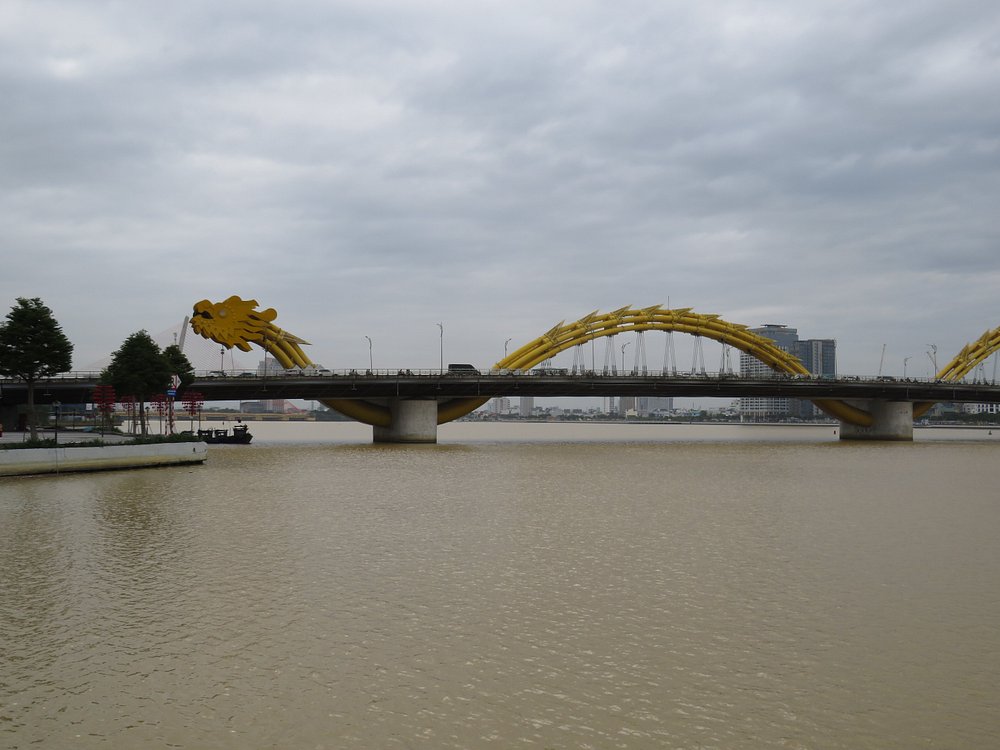
Our first half-day in Da Nang was mostly just exploring. My young son was fascinated the famous Dragon Bridge over the river (even more when he saw it lit up at night), we found our favourite restaurant – which was more garden than restaurant, and we basically just explored the city a bit.

The next day (Dec. 19) was when the adventure really began. Our first trip was out to see the fabled Marble Mountains – a group of five limestone peaks situated seven kilometres from downtown Da Nang. They are each named after one of the five elements: Kim (metal), Thuỷ (water), Mộc (wood), Hoả (fire) and Thổ (earth). It was one of the most beautiful places I ever been. I think the serenity of the rain actually enhanced the experience… we climbed up the rocky paths through the jungle, and at every turn there was a shrine, a pagodas, a wall carved out of the rock, or a mysterious cave. And then you make it to the top and see the view of the surrounding countryside and realize just how odd it is for these 5 large slabs of limestone to be sticking out of the ground. It was amazing.

Our next stop was to visit the Linh Ung Pagoda on the Son Tra Penisula – which is about 10 kilometres away from Da Nang. According to local legend, during the reign of emperor Minh Mang, Nguyen Dynasty, a Buddha statue drifted to the sandbank of Son Tra Peninsula. Believing that this was an auspicious sign, the local fishermen built a shrine to worship Buddha. Since then, the waves of the sea became calmer, making it easier for local people to do fishing work.
The pagoda has an area of 20 hectares with a complex of buildings including the main hall, the ancestor’s house, the lecture hall, the library, the cafeteria, and the Arhat statue garden, so there’s a lot to check out. However, the main attraction is the 67-metre-tall, white statue of the Goddess of Mercy (Quan Âm) – the tallest Buddha statue in Vietnam. Even on a cloudy day it was a sight to behold. The statue stands on a lotus-shaped foundation that has a 35-metre diameter. Inside the statue is a 17-metre-wide area that includes 17 floors, and there are 21 Buddha statues on each floor. I’ve seen large Buddhist statues in Hong Kong and Korea before, but this one was something special.
The next day we took a day-trip to Hoi An, a UNESCO World Heritage site about 27 kilometres south of Da Nang. Hoi An is a remarkably well-preserved 15th-19th century trading port renowned for its yellow, lantern-lit Ancient Town. We got there a bit earlier than I think we should have. Most of the shops weren’t open and it’s mostly driven by the tourist trade. So, there’s wasn’t that much to do except walk along the numerous winding streets and go shopping. Later in the day we were able to hire a lady and a boat to take us on a tour, and I think that was the highlight of the entire day. The Thu Bon River flows right through the heart of Hoi An, so going up and down the river on a boat was a fun way to see it in all its glory (and a good way to rest our sore feet).

We were on a roll with UNESCO World Heritage sites, because the very next day we took another day trip – this time about 40 kilometres southwest from Da Nang to visit the Mỹ Sơn Sanctuary. It was a very different experience from the various Buddhist pagodas and temples we’d seen up to that point. Mỹ Sơn features abandoned, partially ruined Hindu temples dedicated to Shiva built by the Champa Kingdom from the 4th to the 13th centuries. The temples were all built in a very distinctive red brick architectural style and apparently the Champa people built over 70 of them. Unfortunately, many of them were damaged by war, and some of them seem to be hanging on by a thread from total collapse.
China has certainly has had an important cultural influence on Vietnam (which continues to this day), but it was interesting to see just how much of a Southeast Asian/Indian history and cultural influence there was as well. It was a bit unexpected.
After 3 full days of touring amazing sites, our final day in Da Nang was a bit more chill. We explored the city a bit more and found a nice little market that sold a variety of housewares and other useful bits. I stopped by a few bookstores looking for my Tintin book – to no avail, and then we ate yet another amazing meal at our favourite garden… I mean restaurant. It was still raining, but that didn’t stop us from playing a bit more on the beach. All in all it was a wonderful way to launch into the 2014 Christmas break.
Discover more from strobez
Subscribe to get the latest posts sent to your email.
